
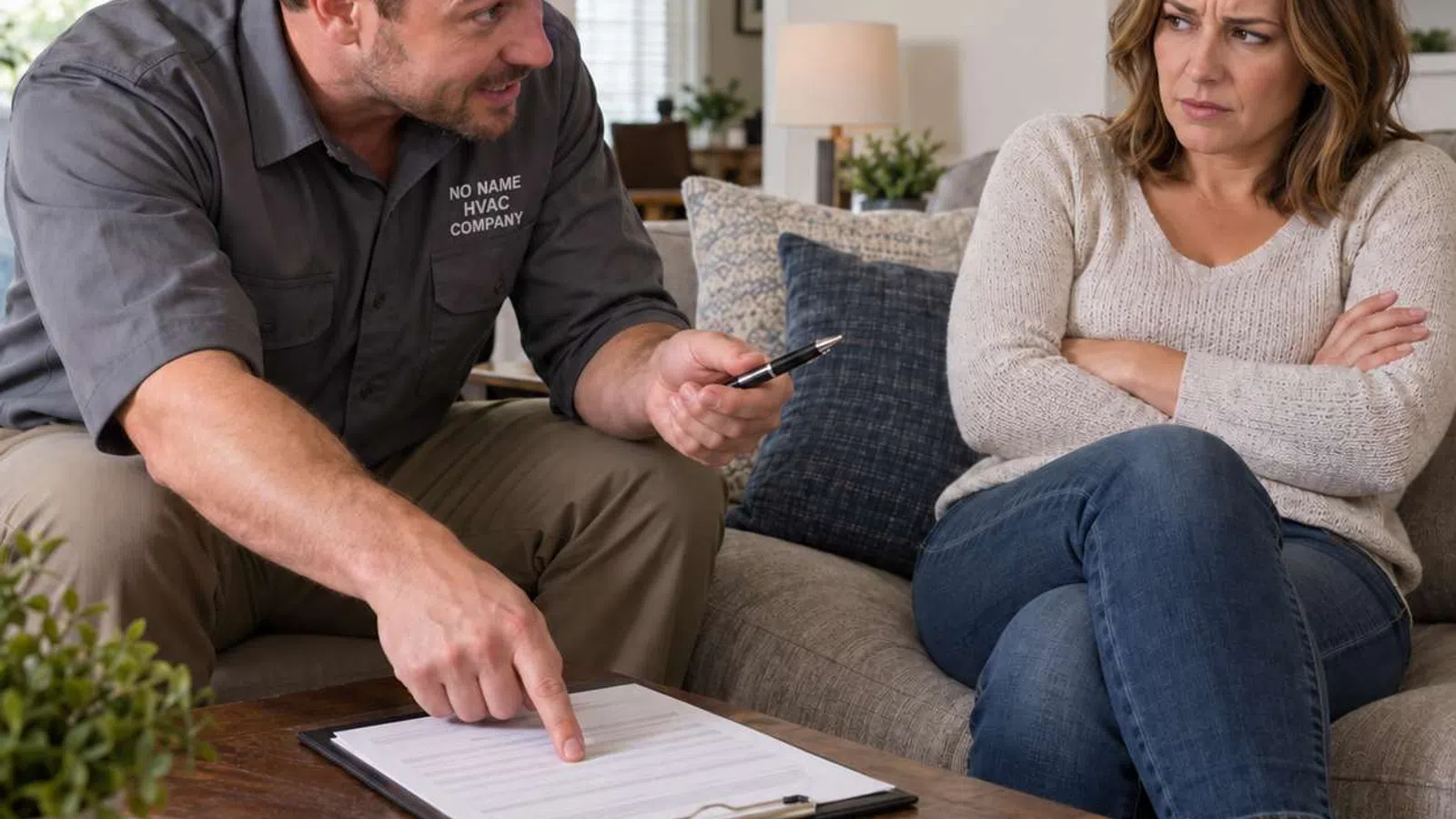
Most HVAC companies are honest, but the ones that aren't have gotten good at sounding convincing. At Guardian Home Experts, we hear the aftermath of these scams constantly from homeowners across Metro Atlanta, Marietta, Kennesaw, Acworth, Sandy Springs, and Smyrna — usually after the damage is already done. Here are the tactics we see most often, along with a few others that show up nationally, so you know what to watch for before you're the one signing on the dotted line.
Scare Tactics: Manufacturing a Crisis
The number one scam we see is fear-mongering. Homeowners are told they're at risk of carbon monoxide poisoning, or that poor air quality is going to cause cancer, when neither claim is actually supported by what's really going on with their system. The goal isn't to inform you — it's to panic you into an expensive decision before you have time to think it through.
We were once called out for a second opinion after a customer had already been told their heat exchanger was cracked and their system needed replacing — a $5,000 to $10,000 decision. When we investigated, we found the "evidence" they'd been shown was photos of a completely different unit. It wasn't even their system. That's not an exaggeration or a misdiagnosis — that's a fabricated crisis, built entirely to close a sale.
The "Quick Fix" That Ignores the Real Problem
The inverse of the scare tactic is just as damaging: the "you don't need all that" scam. Some technicians will replace or patch a single part just enough to get your system running again, without ever addressing the actual root cause. It feels like a win in the moment — a fast, cheap repair — but the underlying issue is still there, and you end up paying for the same problem twice, sometimes with more damage the second time around.
This shows up in more specific forms too. A technician recommending a refrigerant recharge without ever diagnosing why the refrigerant is low is a version of this — refrigerant doesn't just disappear, it leaks, and recharging without repairing the leak is a temporary fix sold as a permanent one. Some homeowners have also reported a "dirty filter" version of this scam, where a technician brings in a filthy filter that never came from the home at all, using it to push an expensive air quality product the homeowner didn't actually need.
Payment and Contract Red Flags
Cash-only deals, no written contract, and paper-only paperwork with no electronic trail are all warning signs. We've heard directly from customers who paid cash to a paper-only company, only to later get a collections call because an employee at that company pocketed the cash and claimed the homeowner never paid. Accountability and traceability protect both the homeowner and the business — a company with nothing to hide will always give you something in writing, and ideally something documented electronically as well.
The Better Business Bureau echoes this: avoid large upfront payments, get everything as a written estimate rather than a verbal promise, and be especially cautious with payment methods like cash apps or cash itself that leave you no way to dispute a charge later.
Who's Actually Standing in Your Home?
Unmarked vehicles are a red flag. So is someone showing up in a marked company vehicle while clearly doing side work off the books. Hiring an unlicensed technician is one of the biggest risks a homeowner can take, because if something goes wrong — and in HVAC and plumbing work, plenty can — there's no one accountable and no insurance behind the work. Avoid finding contractors through social media marketplaces. A company that's taken the time to properly license itself, insure itself, and train its technicians is worth the investment. A "side show Bob" looking for quick cash might save you money upfront, but the horror stories our own technicians get called out to fix afterward almost always end up costing homeowners more in the long run.
High-Pressure Sales and Manufactured Urgency
Some larger, private-equity-owned companies train their sales teams specifically in high-pressure tactics: an inflated price, paired with a sudden "manager's discount" of 30-40% off if you sign today. This preys on urgency — homeowners in genuine discomfort, or customers who trusted a company before it was bought out and changed how it operates.
It's worth understanding that equipment costs are relatively consistent across legitimate companies — most pay within a few hundred dollars of each other for the same units. If a quote is thousands of dollars higher or lower than everyone else's for the same job, ask why. Something is either being padded on the high end, or cut on the low end.
Other Warning Signs Worth Knowing
A few additional red flags worth keeping in mind, based on patterns seen across the industry nationally: verbal-only offers with nothing in writing, technicians who can't or won't show you certification or licensing when asked, door-to-door solicitation (especially right after a storm, when scammers know homeowners are desperate and not thinking clearly), and any offer that feels too good to be true compared to every other quote you've gotten.
Protect Yourself With Guardian Home Experts
The best defense against any of these tactics is the same: ask questions, get everything in writing, and get a second opinion before agreeing to a major repair or replacement. Guardian Home Experts serves homeowners throughout Metro Atlanta, Marietta, Kennesaw, Acworth, Sandy Springs, and Smyrna, and we're glad to be the second opinion that either confirms a diagnosis or catches a scam before it costs you thousands. If something about a recent estimate or repair felt off, reach out to Guardian Home Experts — we'd rather show you the truth than tell you a story.